
Climate change continues to be one of the greatest challenges of our time. Our industry’s efforts to reduce emissions play a significant role in climate change mitigation. In order to mitigate our impact on the environment and contribute to tackling climate change, we have set ambitious targets to reduce our greenhouse gas emission intensity by the end of 2025.
By the end of 2025, we are committed to:
- 40% absolute reduction in greenhouse gas emissions from our own operations (Scopes 1 and 2)
- 50% reduction in greenhouse gas emissions from logistics (per kg of transported product)
- 20% reduction in greenhouse gas emissions of textile materials (per kg of sourced textile)
- 50% reduction in the water scarcity score of textiles materials (per kg of sourced textile)
2019 figures used as a baseline, except for logistics, which uses 2018 figures.
In 2022, Marimekko committed to the Science Based Targets initiative (SBTi) to set science-based, even more ambitious targets for emissions reductions throughout its value chain in line with the UN Paris Climate Agreement. Marimekko will set the science-based emissions reduction targets in accordance with the schedule of the SBTi within two years from the commitment, d.
For partner suppliers’ environmental practices, such as management of emissions, effluents, and waste as well as handling of chemicals, the requirements are set in Marimekko’s Supplier Code of Conduct. The company’s sourcing teams regularly gather and assess information about environmental impacts in the supply chain in order to plan future actions.
In addition to reducing greenhouse gas emissions from the company’s entire value chain, we finance climate protection projects based on the remaining emissions from certain emission sources. Read more in Marimekko’s year 2023 publication.
The carbon footprint of Marimekko’s value chain
In order to measure our progress against our sustainability targets, we calculate the greenhouse gas emissions from our entire value chain (Scopes 1–3) annually in line with the Greenhouse Gas Protocol standards (GHG Protocol).
The calculation has showed that the direct emissions from our own facilities and vehicles (Scope 1) and indirect emissions of our purchased energy (Scope 2) represent less than one percent of our emissions, while over 99 percent of our emissions result from other indirect emissions in our value chain (Scope 3). Most of the Scope 3 emissions originate from purchased goods and services, the use of sold products, and logistics.
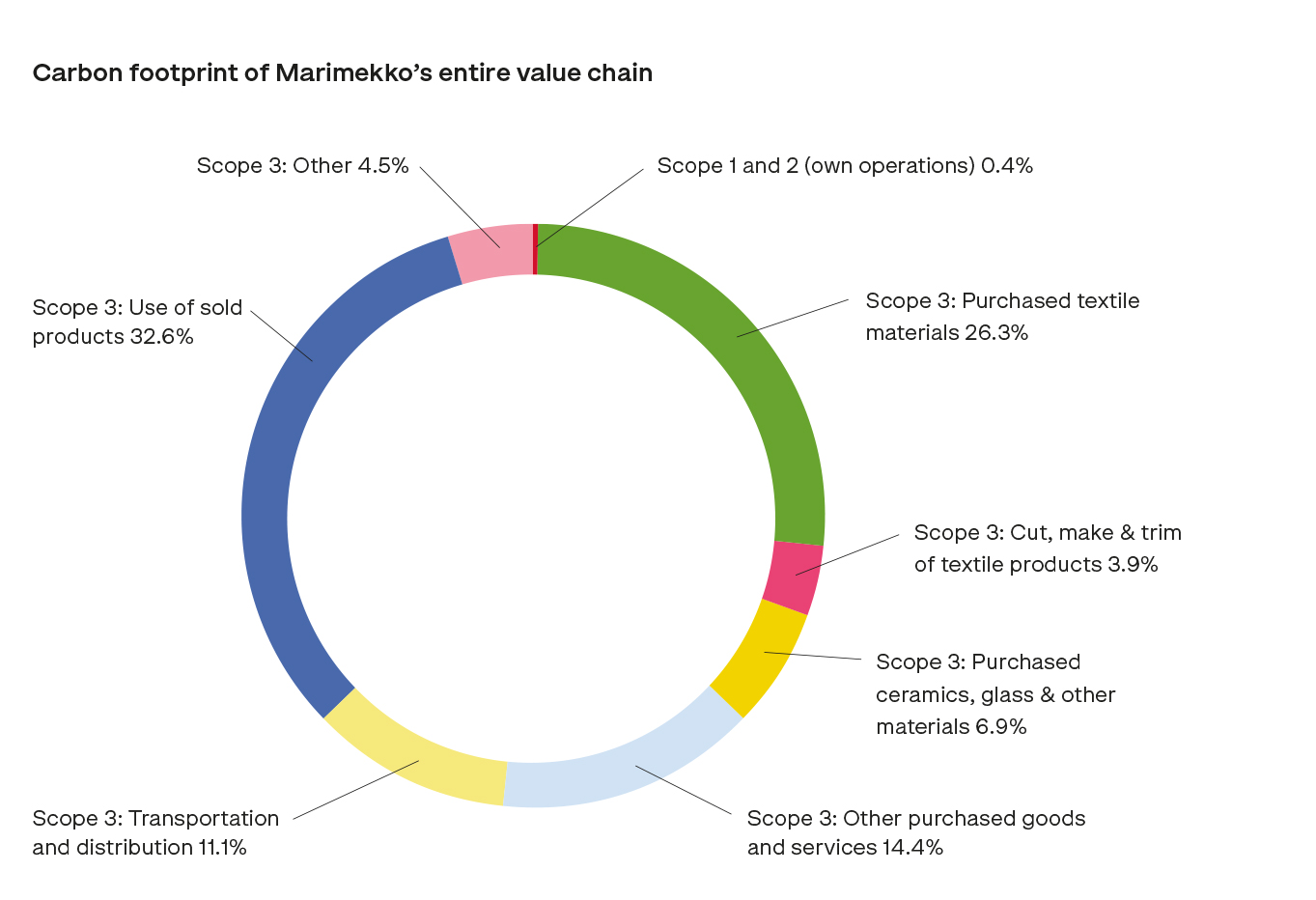
Marimekko achieved already in 2022 its target to reduce emissions from its own operations (Scope 1 and 2) by 40 percent by the end of 2025. In 2023, Marimekko’s Scope 1 and 2 emissions were 71 percent lower compared to 2019. The most significant action contributing to the achievement of the target has been the transition to renewable district heating at Marimekko’s headquarters and printing factory, located in Helsinki in 2022. In 2023, the share of renewable energy of all energy purchased and produced by Marimekko was 92 percent (91). To further reduce emissions from its own operations, Marimekko continues its transition to renewable energy.
By the end of 2025, our goal is to reduce the emissions from our logistics per kg of transported product by 50% compared to baseline year 2018. In 2023, the greenhouse gas emissions of our logistics per kilogram of transported product were 33 percent lower compared to 2018. The main means to reduce emissions from logistics are optimizing transportation routes and choosing lower-emission modes of transport. We continuously seek lower emission alternatives for the delivery of our products, and finance climate protection projects based on the remaining emissions from our e-commerce deliveries to Finland. As in previous years, in 2023 Marimekko acquired carbon credits corresponding to the emissions caused by e-commerce deliveries to Finland and Europe, partly directly and partly through its partner DHL express.
Significant share of greenhouse gases emitted during the lifetime of a long-lasting garment relates to its care, including machine washing, drying and ironing. To support sustainable consumer behavior that reduces emissions within our value chain, we strive to enhance the careability and repairability of our products, provide customers material-specific care instructions as part of our care guide, and increase our offering of lifecycle services.
Marimekko’s material strategy
We want to create items that truly last in use, and thus a key consideration for us when choosing materials is their quality. Through material choices we can also reduce the environmental impacts in our upstream value chain, and therefore we are committed to increasing the share of, e.g., less emission-intense and water consuming materials in our products and packaging.
A key measure in reducing our carbon footprint is the execution of our material strategy. With the material strategy, we aim to increase the use of conventional enhanced, organic, recycled and less emission-intensive materials and reduce the use of conventional materials. The rollout of this material strategy began in the beginning of 2021 and the results started to be visible from the 2022 collections forward.
Our goal is to reduce the emissions of textile materials per kg of sourced textiles by 20 percent by the end of 2025 compared to baseline year 2019. In 2023, the greenhouse gas emissions of our textile materials per kilogram of sourced textiles decreased by 9 percent from 2019 (calculated based on Higg MSI 3.7 data at Higg.org). Reductions in the emission factors of several materials and the increased share of recycled and organic textiles in the collections contributed to the decreased emission intensity. On the other hand, increased share of emission-intensive animal derived materials, such as leather and wool, slowed the positive development in emission intensity of textile materials. The more versatile material selection better corresponds to customer needs but makes it more difficult to reach the set target.
We are committed to sourcing 100 percent of our cotton as Better Cotton, organic or in-conversion cotton, and recycled or traceable cotton by the end of 2023. In 2023, 57 percent of the cotton sourced was Better Cotton (81), 29 percent organic cotton (10) and 9 percent recycled cotton (6), while the share of conventional cotton was 5 percent (18).
Marimekko was the first Finnish company to join the international Better Cotton in 2013. Better Cotton’s mission is to help cotton communities survive and thrive while protecting and restoring the environment. Better Cotton is sourced via a chain of custody model called mass balance. This means that Better Cotton is not physically traceable to end products, however, Better Cotton Farmers benefit from the demand for Better Cotton in equivalent volumes to those we source.
To support material sourcing, we have established Marimekko’s Product Policy that defines our sustainability requirements for the materials and their production processes and bind our suppliers Product Policy can be found on the guiding principles page.
The cotton we use comes from different parts of the world, for example, from India, Brazil, the United States, Turkey and Pakistan. We do not accept materials from very high-risk areas. We define very high-risk areas in our Product Policy, which binds our suppliers. Our partner suppliers must provide information about the origin of the materials used, such as cotton, annually or more frequently if necessary.