
Respecting human rights is a key commitment for Marimekko and therefore an important part of our sustainability work. In our industry, the most significant human rights impacts are linked to global supply chains, which is why we focus particularly on identifying, preventing and mitigating impacts in collaboration with our suppliers and other stakeholders.
Human rights challenges in supply chains
Global sourcing chains in the textile industry involve structural human rights challenges. From Marimekko’s perspective, the key impacts relate in particular to working conditions and occupational safety in production, the realization of a living wage, freedom of association and worker representation, and risks related to child and forced labour in raw material production. We do not accept materials from very high-risk areas, and this policy is binding for all our suppliers.
Children’s rights are particularly important to Marimekko. We do not accept the use of child labour in any part of our value chains. We have joined a working group of The Centre for Child Rights and Business, where member companies can share information and best practices on taking children’s rights and human rights into account in their business operations.
Identifying and preventing risks is ongoing work that we continue to develop as part of our human rights due diligence process.
Contract manufacturers and audits
We monitor our contract manufacturers’ compliance, including adherence to Marimekko’s Supplier Code of Conduct, in several ways. We are part of the amfori BSCI initiative, which provides tools for monitoring and improving working conditions in global sourcing chains. Suppliers that sign our Supplier Code of Conduct also commit to complying with amfori BSCI principles. The requirements in our Supplier Code of Conduct include, for example, zero tolerance for discrimination, child labour and forced labour, respect for workers’ freedom of association and right to collective bargaining, and safe and healthy working conditions.
In practice, our monitoring of suppliers includes, among other things:
- third-party social audits, especially in higher-risk countries
- our own factory visits and dialogue with suppliers
- planning and follow-up of corrective actions based on audit findings
In 2025, 100% of products sourced from outside the EU were covered by social audits. Audits almost invariably identify areas for improvement, which is typical in manufacturing operations in the textile industry. Any development areas identified in audits are addressed together with suppliers and, when needed, a corrective action plan is prepared. Read more in Marimekko Year 2025.
With the support of skilled and versatile contract manufacturers, we are able to offer our customers a broad and high-quality product assortment. A network of around 140 contract manufacturers produces Marimekko products, and in 2025, 54% of Marimekko products sold were manufactured in Europe and 46% in Asia. Below you can see the origin of Marimekko products as a share of sales in 2025.
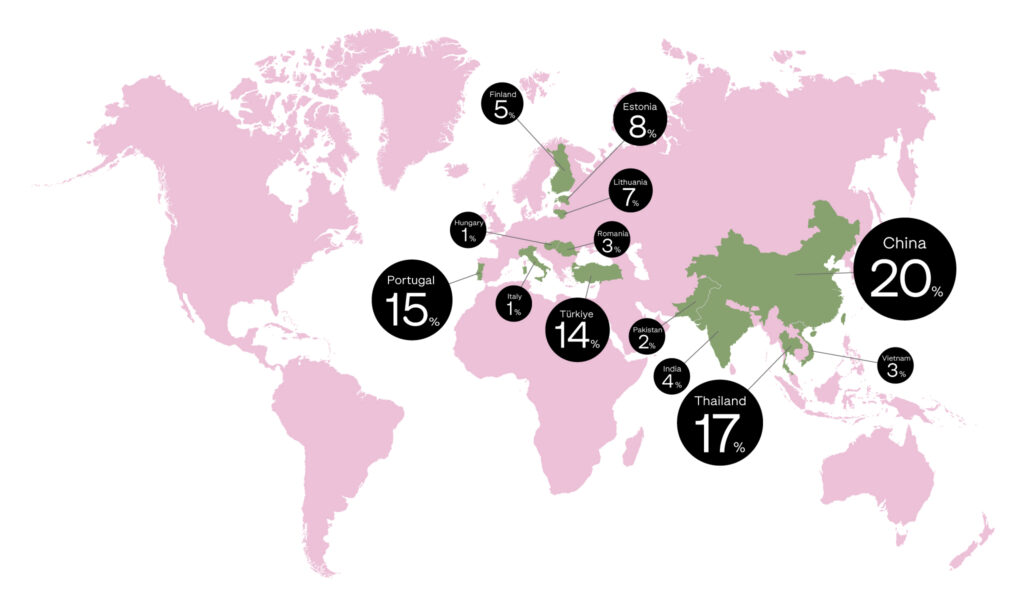
We publish key sourcing-related documents, such as the list of contract manufacturers, the Supplier Code of Conduct and our sustainability policy, on our principles, policies and reporting page ›
Living wage in the value chain
Ensuring fair pay is a key element in advancing human rights. Both the amfori BSCI Code of Conduct and Marimekko’s Supplier Code of Conduct include a requirement for a living wage that enables a worker and their family to earn a decent livelihood.
We recognize that statutory minimum wages or wages based on collective agreements are not sufficient in all countries to meet this objective. Advancing a living wage is a complex issue that requires collaboration among companies, legislators, worker representatives and other stakeholders. Marimekko promotes this work as part of amfori BSCI initiatives and develops its approach together with partners.